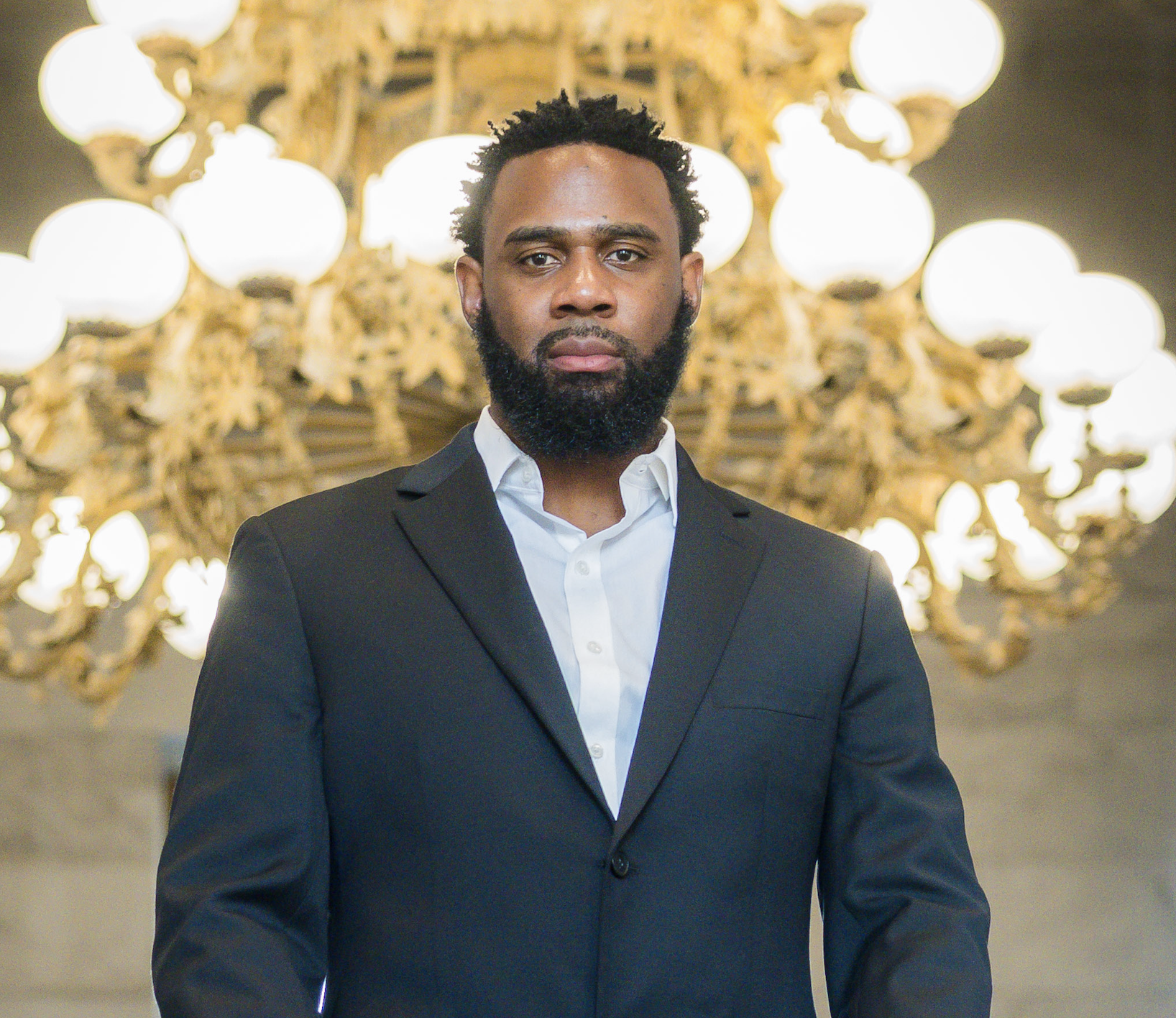
Rodriquez Wright II knocked on doors in more than a dozen states before building Leo Operations, the Nashville firm behind campaigns for a district attorney, council members and judges.
By Jason Luntz
On election night, the cameras find the candidate. They rarely find the person who drew up the walk lists, hired the canvassers and spent the last month of the race on four hours of sleep.
In Nashville, that person has often been Rodriquez Wright II.
Wright, who goes by Rod, has spent more than a decade inside local and national campaigns without his name on a single yard sign. He managed District Attorney Glenn Funk’s 2022 re-election. He ran digital strategy for Metro Council members Zulfat Suara and Burkley Allen in 2019 and again in 2023, when both won seats on the city’s first at-large slate made up entirely of women. In 2020 he led Tennessee organizing for Mike Bloomberg’s presidential campaign.
“I was taught to be behind the scenes, so I never put my name out there,” Wright said. The work, not the credit, was the point.
Learning politics at TSU
Wright’s political education started at Tennessee State University, where he studied English and made the dean’s list. In the spring of 2012, his senior year, he worked as a legislative intern for state Sen. Ophelia Ford of Memphis. He researched bills, kept her calendar and fielded calls from constituents and lobbyists.
The General Assembly took notice. Senate Joint Resolution 905, passed that April, commended Wright by name for his service as an intern.
“Senator Ford’s office was my real classroom,” Wright said. “I got to see how a bill actually moves, who’s calling, who’s showing up and who’s just talking. You can’t learn that in a textbook.”
That fall he was back on the ground as a Davidson County field organizer for the Tennessee Democratic Party, coordinating more than 100 volunteers across four legislative districts. Over the next three years he worked at the Nashville public affairs firm Calvert Street Group, managed Allegra Walker’s winning 2014 race for General Sessions judge, and finished a master’s in public administration at TSU.
In 2015 he joined former Vice Mayor Howard Gentry’s campaign for mayor as deputy campaign manager and took over as campaign manager that summer. Gentry finished fourth. Wright moved on to the runoff as David Fox’s community outreach director.
The loss stung, but it showed Wright where campaigns are actually won: on doorsteps, in volunteer rosters and in the spreadsheets nobody outside the office ever sees. Within weeks he was on the road.
“Losing teaches you more than winning ever will,” he said. “After that race I knew I needed to see how it was done everywhere else, so I went wherever they would send me.”
A decade on the doorsteps
For the next five years Wright went wherever the field work was.
With Revolution Field Strategies, a Boston canvassing firm, he ran signature drives and voter contact programs across the country. In Massachusetts in 2015 he oversaw 361 paid canvassers who gathered more than 109,000 signatures for a ballot measure on hospital prices, according to Wright’s records. The measure qualified, and its backers later dropped it in exchange for a deal at the State House.
In Montana the next spring he opened offices in Billings, Bozeman, Great Falls and Missoula for I-181, a proposed brain research bond program that made the November ballot. That fall he was in Las Vegas running a voter registration drive that signed up nearly 11,000 new voters, then in Chicago leading a get-out-the-vote canvass in the final weeks of the 2016 election. Between those stops he worked Hillary Clinton’s New Hampshire primary.
The pace didn’t let up. In 2017 his teams made three passes through 76,000 Kansas City doors ahead of an $800 million infrastructure bond vote that passed that April. He then moved to San Diego to manage Omar Passons’ campaign for county supervisor, raising more than $300,000 from 1,462 donors and landing the San Diego Union-Tribune’s endorsement.
In 2018 he ran petition drives for Arizona’s Invest in Ed school funding measure and for All for Transportation in Tampa, where his team of 115 canvassers collected about 77,000 signatures for a transit tax that voters approved that November. By fall he was home, running BlackPAC’s Tennessee canvass. Over three months, 210 paid canvassers knocked on more than 247,000 doors in Memphis, Chattanooga and Knoxville.
All told, Wright says the teams he has led have knocked more than 650,000 doors and gathered more than 250,000 petition signatures in more than a dozen states.
“Every door is a different conversation,” Wright said. “Montana is not Memphis. But at the end of the day people want the same thing. They want somebody to actually listen to them.”
Running Tennessee for Bloomberg
In late 2019 Wright was in Chicago, directing a canvass for The Black Institute’s #KeepStarz campaign against Comcast’s plan to charge subscribers extra for the Starz channel. Comcast and Starz reached a deal to keep the channel that December.
By then a bigger call had come. Former New York Mayor Michael Bloomberg was entering the 2020 Democratic primary late and spending heavily in Super Tuesday states, including Tennessee. When the campaign announced its Tennessee team in December 2019, the Nashville Post reported that Wright would serve as organizing director, alongside outreach director London Lamar, now a state senator.
The operation ran out of a downtown Nashville headquarters and offices across the state. Wright trained and managed seven regional directors and 23 field organizers in Nashville, Memphis, Chattanooga, Knoxville, Jackson, Murfreesboro and Johnson City. In about three months the team held 539 events, made more than 228,000 calls and knocked on nearly 61,000 doors, by the campaign’s internal count.
“We built that whole program in about three months,” he said. “Super Tuesday wasn’t waiting on anybody, so you hire, you train and you’re on the doors the same week.”
Bloomberg finished well behind Joe Biden in Tennessee’s March 3 primary and left the race the next day. For Wright, the campaign was proof he could run a statewide program from the ground up. It also convinced him to put all of that experience into something of his own.
Building Leo Operations
Wright had started Leo Operations in 2019, and in July 2020 he made it official, incorporating the company in Tennessee. The pitch was simple. Most campaigns hire one shop for strategy, another for field, another for video and a fourth for digital ads. Leo would do all of it under one roof, run by someone who had spent a decade on the doorsteps.
“As a campaign manager, my job is to make sure everything is on one accord for the candidate,” Wright said. “The message at the door, the video, the ads, the social media, it all has to say the same thing. When you’ve got four different companies that never talk to each other, that’s hard to do. So I built one team that does all of it.”
The firm now offers campaign management, field organizing, video and photo production, television, streaming and social ads, websites and social media. Its client list reads like a guide to Nashville’s Democratic leadership: Mayor Freddie O’Connell, former Vice Mayor Jim Shulman, Property Assessor Vivian Wilhoite and Register of Deeds Karen Johnson.
At the Capitol, Leo has worked with state Sens. Raumesh Akbari, Heidi Campbell, London Lamar and Charlane Oliver, and state Reps. Shaundelle Brooks, Jesse Chism, Gloria Johnson and Justin Jones.
On the bench, Leo has worked with Chancellor I’Ashea L. Myles and Judges Ana Escobar, Jennifer Smith, Stephanie Williams, Angelita Blackshear Dalton, Cynthia Chappell, Robin K. Hayes and Marcus Floyd.
On the Metro Council, the roster covers much of the body: at-large members Olivia Hill, Zulfat Suara and Burkley Allen, along with Jennifer Gamble (District 3), Mike Cortese (District 4), Clay Capp (District 6), Emily Benedict (District 7), Russ Bradford (District 13), Brenda Gadd (District 24), Tasha Ellis (District 29) and Joy Styles (District 32).
Some of the work is strategy. Wright managed Funk’s 2022 re-election, when the district attorney held off a well-funded primary challenge. Some is digital: he advised Suara and Allen through two Council at-large races and, this year, Sharon Hurt’s successful run for Davidson County Clerk. In 2023 the firm worked as a field consultant for SEIU Virginia as Democrats took control of both chambers of the Virginia General Assembly.
Much of it happens behind a camera. Leo has shot campaign ads for state Sen. Heidi Campbell’s successful re-election and for state Senate candidate Karen Reynolds, covered Megan Barry’s 2024 run for Congress and filmed canvassers for Dan Osborn’s U.S. Senate campaign in Nebraska. Outside politics, its clients have included the Memphis Grizzlies, Meharry Medical College, Planned Parenthood of Tennessee and North Mississippi and the National Black Caucus of State Legislators, whose 2023 conference brought it to Nashville for the first time since 1977.
Still in the background
These days Wright’s name shows up in more places than it used to. He owns Washington DC Magazine, a digital publication covering politics and culture in the nation’s capital, and this fall he covered the Congressional Black Caucus Foundation’s 50th Phoenix Awards for it.
But the campaigns are still the core of the work, and he still runs them the way he learned at TSU and on all those doorsteps: quietly, with the candidate out front.
“I don’t need my name on the sign,” he said. “I need my candidate to win. That’s the job.”
On the next election night in Nashville, the cameras will find the winners again. Somewhere behind them, odds are, Wright will be checking the precinct numbers.